My Journey to a Secondhand Only Wardrobe: Tips, Challenges, and Triumphs
Can you really build a complete, stylish wardrobe without buying a single new item? I spent 18 months testing that exact question. No fast fashion. No mall trips. No online orders from brand websites. Everything I wore — from socks to winter coats — had to be secondhand.
Here’s what actually worked, what nearly broke me, and the exact strategies I’d use again.
Why I Went Secondhand Only — And Why It Almost Failed
I started for the money. My clothing budget was out of control — roughly $200 per month on new pieces that I’d wear twice. Thrifting seemed like the obvious fix. But I made three critical mistakes in month one that nearly derailed everything.
Mistake #1: Shopping Without a List
I walked into a Goodwill with zero plan. Two hours later I’d bought a sequined top I’d never wear and a pair of boots one size too small. Never shop secondhand without a written list of what you actually need. My list now reads: “black trousers, white linen button-down, leather belt.” That’s it. If it’s not on the list, it stays on the rack.
Mistake #2: Ignoring Fit Alterations
Secondhand clothes rarely fit perfectly off the rack. I wasted good money on items that were “close enough” but never got worn. A $12 pair of Levi’s 501s with a $15 tailoring cost became my favorite jeans. Budget $10–$20 per item for alterations. It’s worth it.
Mistake #3: Buying Stains and Pilling
You cannot fix certain fabric damage. Stains on silk, pilling on acrylic sweaters, or stretched-out elastic in waistbands — these are not bargains. Check every item under bright light before buying. Hold it up. Turn it inside out. If it looks worn, it is worn.
The Real Cost Breakdown: What I Actually Spent

Here’s the honest math from my 18-month experiment. I tracked every dollar.
| Category | Items Bought | Total Spent | Average Per Item |
|---|---|---|---|
| Tops (tees, blouses, sweaters) | 22 | $215 | $9.77 |
| Bottoms (jeans, trousers, skirts) | 14 | $178 | $12.71 |
| Outerwear (jackets, coats) | 6 | $145 | $24.17 |
| Shoes | 8 | $92 | $11.50 |
| Accessories (belts, bags, scarves) | 10 | $67 | $6.70 |
| Totals | 60 | $697 | $11.62 |
For comparison, my previous 18 months on new clothing cost roughly $3,600. That’s an 80% reduction. The catch: I spent way more time hunting. About 3–4 hours per week versus 30 minutes online shopping.
The biggest surprise? My most expensive secondhand piece — a Patagonia down jacket for $45 — was still 70% cheaper than retail ($179). That jacket alone validated the entire project.
Where to Actually Find Quality Secondhand Clothes
Not all thrift stores are equal. I tested six different sourcing channels. Here’s what each one delivered.
Thrift Stores (Goodwill, Salvation Army, Local Shops)
Best for: basics, denim, outerwear. I found my best Levi’s 501s at a small-town Goodwill for $8. The key is location: stores in wealthier neighborhoods consistently have better brands (Patagonia, Carhartt, J.Crew). Stores near universities have more trendy fast fashion — skip those if you want quality.
One specific tip: Go on Tuesday mornings. Most stores restock Monday evening. Tuesday at 9 AM is when the fresh racks hit the floor.
Online Resale Platforms (Depop, Poshmark, The RealReal)
These work for specific items you cannot find locally. I bought a pair of Everlane Day Gloves on Depop for $35 (retail $68). The search filters are your friend — set your max price at $30 and sort by “newly listed.”
The RealReal is excellent for designer pieces if you know your measurements exactly. I picked up a Theory wool blazer for $65 that originally sold for $395. But you cannot return sale items, so measure twice.
Estate Sales and Garage Sales
This is the hidden gold mine. Estate sales often sell entire closets for pennies. I once bought 12 vintage silk blouses for $20 total. Use estatesales.net to find sales in your area. Go on the last day — prices drop 50% to clear everything out.
The Items That Are Hardest to Find Secondhand
Some things you will struggle to source used. I had to adjust my expectations on three categories.
Underwear and socks. Obviously. But also workout leggings with compression. Used leggings lose elasticity. Buy these new. Budget $50 per year for new basics.
White button-down shirts. They yellow, they stain, and the collars fray. I found exactly one wearable white shirt in 18 months. Accept that you may need to buy this new or pay for professional whitening.
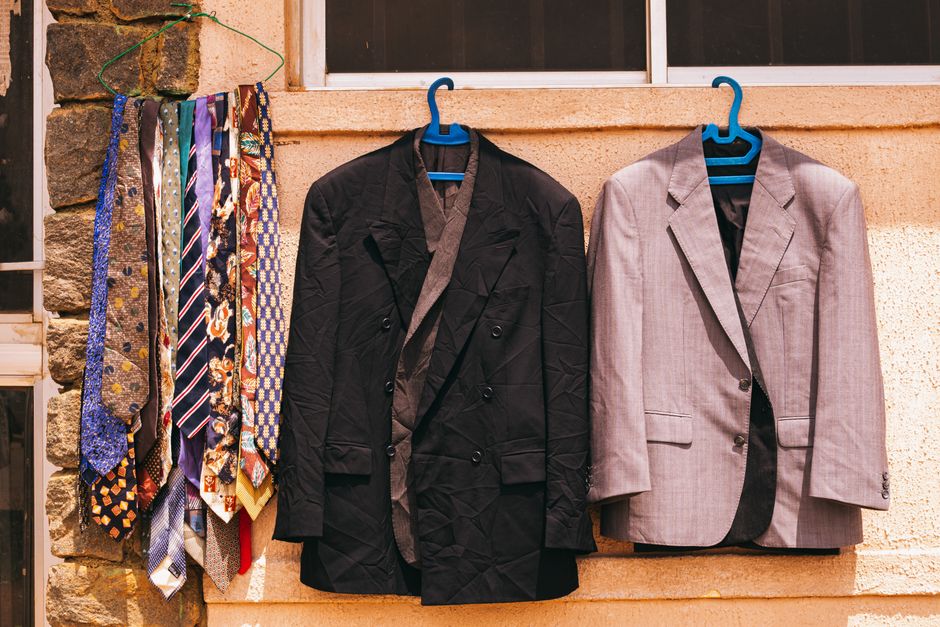
Structured blazers with shoulder pads. Vintage blazers from the 1980s have massive shoulder pads you cannot easily remove. Modern blazers are rare in thrift stores. When you find one that fits, buy it immediately. I missed a perfect J.Crew blazer by 10 minutes and regretted it for months.
My honest recommendation: For these three categories, allow yourself a “new exception.” One new white shirt per year won’t break your secondhand commitment.
When Secondhand Isn’t the Answer — And That’s Okay
I learned that secondhand-only is a personal challenge, not a moral obligation. There are legitimate reasons to buy new.
Footwear with specific support needs. If you have flat feet or require orthotics, used shoes have broken-in insoles that conform to someone else’s foot. I bought one new pair of Brooks Ghost running shoes ($130) because my feet hurt after three months in thrifted sneakers. That was the right call.
Items you will wear 200+ times. A winter parka you’ll wear daily for five years? Buy it new if you cannot find a pristine used version. The cost-per-wear on a $300 new parka worn 1,000 times is $0.30 — cheaper than a $20 used parka you replace every season.
High-moisture activewear. Used yoga pants and gym tops hold bacteria even after washing. I switched to buying new at Old Navy ($12 per pair on sale) and stopped getting skin irritation.
The point isn’t perfection. The point is cutting your clothing waste and spending by 70–80%. If you buy 80% secondhand and 20% new strategic essentials, you’ve already won.