Black is my favourite colour!
You love black. I love black. Half the people reading this probably own more black shirts than any other colour combined. But here’s the question nobody asks: why does your all-black outfit sometimes look like a sad uniform, while someone else’s looks intentional and expensive?
The difference isn’t the colour. It’s how you use it. Black is a high-contrast neutral that reveals every mistake — wrong fabric, bad fit, missing texture — instantly. This article walks through the exact rules, specific products, and common failures that separate “I just threw this on” from “I look like I know what I’m doing.”
Why Black Fails (And It’s Not the Colour’s Fault)
Black doesn’t hide flaws. It amplifies them.
Think about it. A white shirt hides lint. A navy sweater hides pilling. Black shows everything — dust, faded dye, loose threads, uneven seams. That’s failure mode #1: buying cheap black clothing that looks tired after three washes.
Failure mode #2 is worse: wearing all black with zero contrast. Same fabric weight, same finish, same opacity. You become a dark blob. No depth, no movement, no visual interest.
Failure mode #3: ignoring undertones. Black isn’t one colour. A $20 fast-fashion black tee is usually a greyish-black. A $70 Uniqlo Airism tee is a true deep black. A COS wool-blend coat ($295) has a slight charcoal cast. Mixing these without knowing creates a muddy, unintentional look.
The fix starts with one rule: never let two black pieces touch without a deliberate difference between them. Different texture. Different weight. Different finish. That’s the entire secret.
The Texture Rule: 3 Fabrics Minimum Per Outfit
This is the single most practical tip I know. Count the textures in your outfit. If you have fewer than three distinct fabric surfaces, your all-black look will fall flat.
Here’s what that looks like in real life:
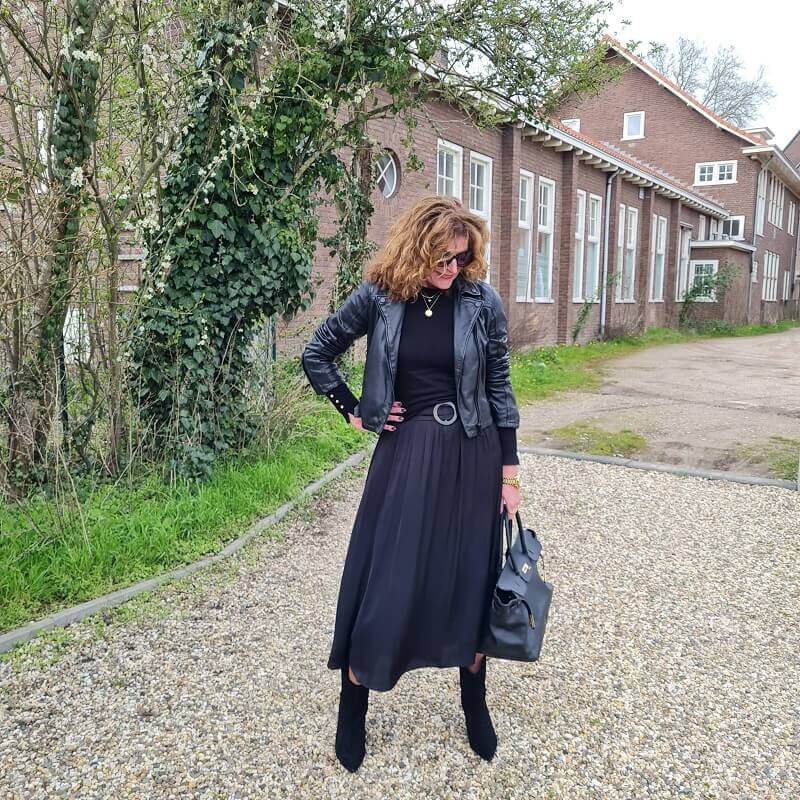
- Cotton tee (matte, soft) + leather jacket (shiny, stiff) + denim jeans (rough, textured) = three textures. Works.
- Cotton tee + cotton joggers + cotton hoodie = one texture. Flat.
- Wool coat (fuzzy, matte) + silk blouse (smooth, lustrous) + leather boots (glossy, hard) = three textures. Elevated.
Specific product examples that nail this:
The Everlane The Cashmere Crew ($128) has a soft, slightly fuzzy hand feel. Pair it with Levi’s 501 ’93 Black Rinse jeans ($98) — a stiff, dark indigo-black denim with visible weave. Add Veja V-10 leather sneakers ($150) with their smooth leather and white accents. Three textures, one colour story. Done.
What about summer? Swap the cashmere for a Uniqlo linen-blend button-down ($40) — that slubby, uneven linen texture. Same jeans. Same sneakers. Still three textures. Still works.
The Shape Problem: Why Proportions Matter More in Black
Black erases visual boundaries. When you wear a black top and black pants, your eye can’t tell where one ends and the other begins. That’s fine if you’re going for a long, continuous silhouette. It’s a disaster if your proportions are off.
Common mistake: oversized black sweater + black leggings. You look like a dark triangle. No waist definition, no leg shape, no structure.
Fix: introduce a deliberate shape break. A belt works. A hemline change works. A jacket with a different length works better.
Try this: COS tailored wool trousers ($135) — wide-leg, creased front, high waist. Tuck in a slim-fit black turtleneck (the Uniqlo Extra Fine Merino Turtleneck ($40) is perfect). Add a cropped black blazer — the Mango Textured Blazer ($80) hits at the waist, not the hip. The blazer creates a horizontal line that separates top from bottom. Suddenly you have a waist, a hip, and a leg line. The all-black works because the shapes do the talking.
For casual: same principle. Black straight-leg jeans (Levi’s Wedgie Fit in Black ($128)) + a fitted black tank tucked in + an open black overshirt that hits mid-thigh. The overshirt creates a vertical column that elongates. The tuck creates a waist. The jeans give shape below.
When NOT to Wear Black (Real Tradeoffs)
Black is not always the answer. Here are three situations where another dark neutral beats black.
1. Very formal daytime events. Black at a daytime wedding or garden party reads as mourning or costume. Navy or charcoal grey is more appropriate. A SuitSupply Navy Linen Blazer ($399) achieves the same slimming effect without the funeral vibe.
2. If you have high-contrast colouring (pale skin, dark hair). Black right next to your face can wash you out. It’s too stark. Dark olive or deep burgundy gives the same drama but softer. The Patagonia Better Sweater in Forge Grey ($139) reads almost-black but has a warmth that complements pale skin.
3. In direct, harsh sunlight. Black absorbs heat. It also shows every wrinkle, dust speck, and fabric imperfection. A dark grey linen shirt ($65 from Uniqlo) stays cooler and looks cleaner in bright light.
The tradeoff is real: black gives you edge and uniformity. But it demands perfect conditions. When conditions aren’t perfect, swap to a near-black neutral and keep the same outfit structure.
Black Footwear: The Make-or-Break Decision
Your shoes either anchor the outfit or ruin it. Black shoes with black pants create an unbroken line that makes legs look longer. But the wrong black shoe — wrong finish, wrong shape — breaks the illusion.
| Shoe Type | Best Match (Pant Style) | Why It Works | Price Example |
|---|---|---|---|
| Black leather Chelsea boots | Skinny or straight-leg jeans | Clean line, no laces, sleek profile | Blundstone #550 ($210) |
| Black chunky sneakers | Wide-leg trousers or cropped pants | Visual weight matches wide leg; prevents top-heaviness | Veja V-10 ($150) |
| Black pointed-toe flats | Any hem that shows ankle | Extends leg line; elegant but casual | Everlane The Day Glove ($145) |
| Black combat boots | Cuffed jeans or midi skirts | Adds toughness; breaks up soft fabrics | Dr. Martens 1460 ($170) |
Critical rule: match the finish of your shoe to the finish of your pant. Matte black jeans + matte black leather boots = seamless. Matte black jeans + patent leather black loafers = jarring. The light bounces differently and the eye catches the break.
One more thing: black socks. If you’re wearing black shoes and black pants, your socks should be invisible or match exactly. A sliver of white athletic sock ruins the line. Darn Tough Micro Crew Cushion in Black ($25) are my go-to — they stay up, don’t pill, and disappear under any black pant.
Accessories: The Only Thing That Saves a Flat Black Outfit
You can break every rule above and still look good if your accessories are right. Accessories create the contrast that fabric can’t.
Silver or gold jewellery. A chunky silver chain (Miansai M20 Hook Chain in Sterling Silver ($195)) against a black cotton tee adds a reflective point that draws the eye. Without it, the tee is just a black rectangle. With it, the outfit has a focal point.
A belt that isn’t black. A brown leather belt (Filson Bridle Leather Belt ($85)) with an all-black outfit creates a deliberate colour break. It says “I chose this.” The same outfit with a black belt says “I didn’t think about it.”
A bag with contrast. A black canvas tote is invisible. A Porter-Yoshida & Co. Tanker Shoulder Bag in Olive ($220) against a black coat is a statement. The olive green is dark enough to not clash, light enough to be seen.
Watches. A black watch on a black band disappears. A Seiko SNXS79K1 ($150) with a stainless steel bracelet and black dial gives a silver rim that catches light. It’s the smallest detail and it matters more than the shirt.
Count your accessories like you count your textures. Three accessories minimum. One metallic. One colour contrast (brown, olive, navy). One functional piece (belt, bag, watch). That’s the formula.
The One-Week Black Capsule: What I’d Actually Pack
Let’s make this concrete. Here’s a seven-day capsule built entirely around black, using the rules above. Every outfit hits at least three textures and one deliberate shape break.
Core pieces (wear every day, mix and match):
- Uniqlo Airism Cotton Tee (black, $20) — base layer
- Uniqlo Extra Fine Merino Turtleneck (black, $40) — warm layer
- Levi’s 501 ’93 Black Rinse (black, $98) — denim anchor
- COS Tailored Wool Trousers (black, $135) — dressier bottom
- Mango Textured Blazer (black, $80) — shape breaker
- Veja V-10 leather sneakers (black/white, $150) — casual shoe
- Blundstone #550 Chelsea boots (black, $210) — smart shoe
- Filson Bridle Leather Belt (brown, $85) — colour break
- Porter-Yoshida Tanker Bag (olive, $220) — contrast accessory
Day 1: Tee + jeans + Vejas + brown belt. Three textures (cotton, denim, leather). One colour break (belt).
Day 2: Turtleneck + trousers + Blundstones + blazer. Four textures (merino, wool, leather, textured blazer). Shape break from blazer hemline.
Day 3: Tee + trousers + Vejas + olive bag. Three textures. Bag provides colour contrast.
Day 4: Turtleneck + jeans + Blundstones + brown belt. Three textures. Belt break.
Day 5: Tee + jeans + blazer + Vejas + olive bag. Four textures. Blazer creates shape break.
Day 6: Turtleneck + trousers + Vejas + brown belt. Three textures. Belt break.
Day 7: Tee + trousers + Blundstones + blazer + olive bag. Five textures. Maximum contrast.
Total investment: about $1,000 for pieces that last years. Compare that to buying five cheap black outfits that look flat after three months. The capsule approach costs less per wear and looks better every time.
Black isn’t boring. Boring is wearing black without thinking about texture, shape, or contrast. The people who make black look effortless aren’t lucky. They’re following these rules. Now you are too.